A concise weekly briefing on notable AI model releases, deployment patterns, research, open-source activity, and governance developments from August 17–23, 2026.
Models / Product Releases
Module pick: SpaceXAI released Grok 4.6 for long-running agentic work.
SpaceXAI said Grok 4.6 is available through its API, Grok Build, Cursor, and partner platforms. The company reported a 500,000-token input window, adjustable reasoning levels, function calling, web/X search, sandboxed code execution, and pricing from $2 per million input tokens and $6 per million output tokens. DeepLearning.AI’s The Batch highlighted the model’s benchmark gains and its emphasis on completing multi-step work with fewer turns.
Other notable items:
- Alibaba’s Qwen team announced Qwen3.8-Max and said it would release open weights for the first Max-class Qwen model, with the official blog describing a 2.4-trillion-parameter model aimed at coding, work, research, and long-horizon tasks.
- The Batch also tracked updates around Claude watermarking and speech-recognition correction research in the same weekly issue.
Enterprise Deployment
Module pick: Cursor began rolling out Origin, a code-hosting product built around agent-scale development.
Cursor said Origin is entering early beta for paid plans, starting with repositories, pull requests, code browsing, GitHub sync, and integrations such as Vercel, Depot, and Buildkite. The release reflects a broader enterprise pattern: AI coding assistants are moving from editor features toward integrated codebase, review, CI, and deployment environments.
Other notable items:
- MIT Technology Review reported on AI use in classrooms, describing school-level policies that distinguish permitted, partial, and prohibited AI use in assignments.
- MIT Technology Review’s daily briefing also tracked public pushback against AI data centers ahead of U.S. midterm elections, citing reporting from major news outlets.
Research Highlights
Module pick: Hawkeye proposed a hardware-aware framework for GPU-kernel optimization by coding agents.
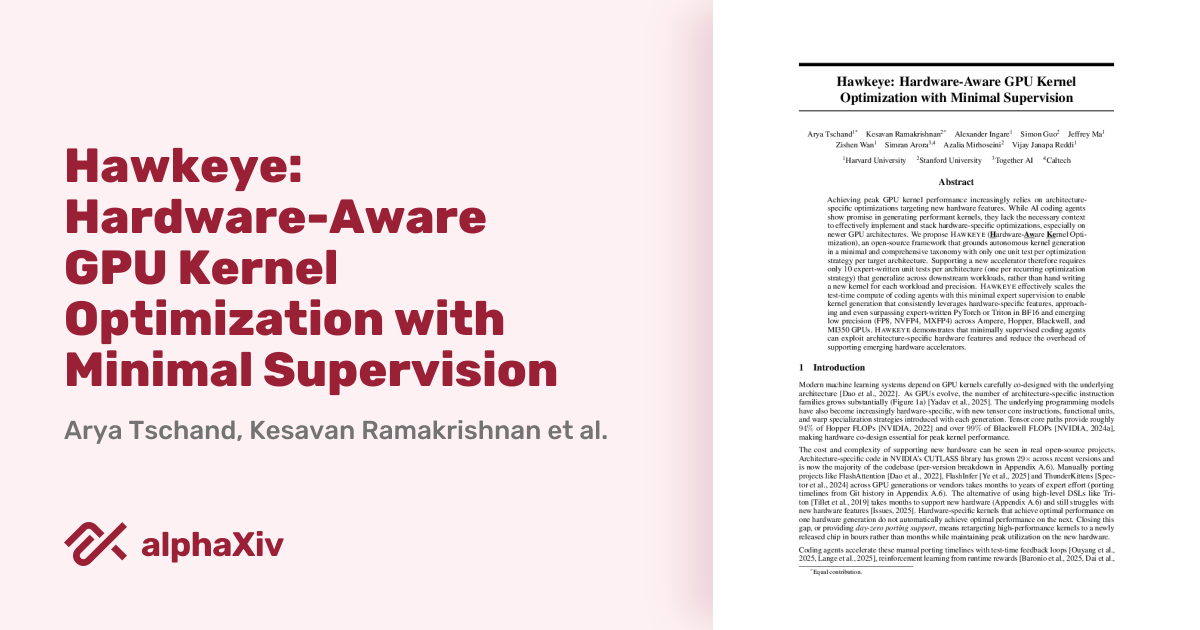
Import AI summarized Hawkeye, a research project from Harvard, Stanford, Together AI, and Caltech, as an open-source framework that gives agents structured unit tests and profiling signals for GPU-kernel generation. The reported evaluations covered NVIDIA and AMD hardware and multiple precision formats, with gains on some emerging attention workloads.
Other notable items:
- Import AI covered SPADE, a self-play framework that generates executable synthetic environments and trains reasoning agents in those environments; the authors reported gains across reasoning and tool-use benchmarks.
- METR published a research note arguing that LLM-linked acceleration is currently easier to observe in cybersecurity vulnerability discovery than in mathematics or AI-research optimization.
Open-source Trends
Module pick: SPADE released code and checkpoints for adaptive synthetic executable environments.
The SPADE paper and GitHub repository show continued open-source interest in post-training environments rather than only model weights. The framework treats environment design as a learnable component, with executable tasks that can support single-turn reasoning and multi-turn agentic behavior.
Other notable items:
- Qwen3.8-Max’s announced open-weight release drew attention because it extends open-weight availability into a Max-class model line, though implementation details and license terms should be checked directly against the official model page before deployment.
- Hawkeye also contributes to open tooling around agentic kernel optimization, a practical area for AI infrastructure and model-serving efficiency.
Industry / Safety / Governance
Module pick: Anthropic detailed Claude text watermarking for future models.

Anthropic said future Claude models will generate text with a statistical watermark and that it is implementing the change to comply with the EU AI Act. The company described the approach as based on Google DeepMind’s SynthID-Text family of methods and said the watermark is not visible to readers, does not add tokens, and is not intended to identify individual users or organizations.
Other notable items:
- Import AI discussed the debate over whether AI systems should ever receive rights, citing arguments against treating AI systems as persons or rights-bearing entities.
- Public concern about AI infrastructure continued to widen beyond technology circles, with data-center siting, energy use, and local political opposition appearing in mainstream coverage.
Sources
- DeepLearning.AI — The Batch, Issue 367: “Anthropic’s Watermarks, Grok 4.6 Surges, Qwen’s Open Weights, Better Corrections for Speech Recognition.”
- xAI / SpaceXAI: “Introducing Grok 4.6.”
- Anthropic: “How Claude’s text watermarking works.”
- Cursor: “Origin Code Hosting.”
- Qwen official blog: “Qwen3.8-Max: A New Bar for Coding and Cowork.”
- Import AI 470: “No rights for machines; automating environment generation with SPADE; and building better GPU kernels with Hawkeye.”
- MIT Technology Review: “How to encourage smarter AI use in the classroom” and The Download briefing items for August 24, 2026.
- SPADE arXiv / GitHub; METR research note; alphaXiv Hawkeye paper preview.